
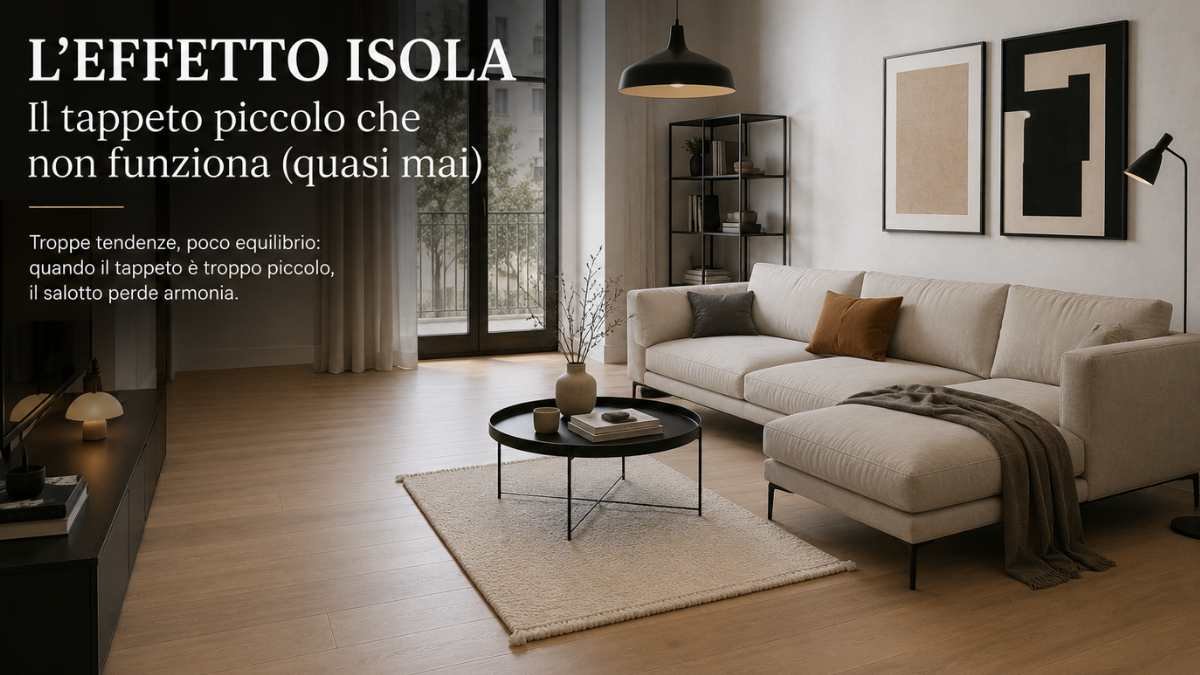

In recent seasons, furniture catalogs have begun to feature living rooms with small, almost minimal rugs placed in the center of the room as stand-alone decorative objects. A square of wool under the table, the legs of the sofa well outside the perimeter, everything floats in the visual air of the parquet. The photo effect works. It works even better on social media. The problem is that what you see in the photo is a room made for a camera, with aspect ratios calibrated for a wide-angle lens and professional lighting. In your living room, with its actual dimensions and its actual furniture, this same logic produces something radically different: a sofa that looks accidentally parked, a coffee table that floats, and a rug that no one quite understands what it’s for.
The subject is not aesthetic in the decorative sense of the term. It’s a matter space grammar: A rug that is too small doesn’t just go wrong proportionally, it disrupts the visual relationships between the pieces of furniture and turns a cohesive group of objects into a collection of separate objects. It’s worth understanding why it happens and most importantly how to avoid it without having to buy a huge rug that you can’t afford or move.
The floor is not a neutral background
One of the most deeply rooted misconceptions in home furnishings is to think of the floor as a passive surface on which furniture is placed. In fact, the way a rug occupies or leaves the floor free determines the perception of the entire living room. A carpet that does not reach the legs of the sofa creates a visual discontinuity: the eye registers two separate levels instead of a single functional area. The result is a living room that appears to be made up of items purchased at different times, even if it isn’t.
The Danish brand Hay has addressed this logic in the Color Carpet series, designed with dimensions starting from 200×300 cm as a basic size for the living room. It is not a commercial choice to sell more square meters: it is a design position. The studio’s designers have openly stated that below this size limit, a carpet in an average European living room loses its anchoring function. It becomes an accessory, not a structure.
Imagine a three-seater sofa with a center table: if the carpet measures 140 x 200 cm, the front legs of the sofa remain on the parquet, the legs of the table touch the edge of the carpet and the whole thing conveys instability. With 200×300 cm, the front legs of the sofa enter the perimeter of the carpet, the coffee table is contained within and the area becomes a cohesive island inside the room.
Little is not always little: confusion is costly
Minimalism as a visual language does not work on the removal of objects, but on the elimination of the unnecessary in favor of the necessary. A small carpet in a living room is not minimalism: it is the absence of a solution. The difference is substantial. Minimalism requires surgical precision in proportions, not downsizing. A living room with a 160×230 cm carpet in good proportion with a 220 cm sofa is more substantial, visually, than a living room with a 120×170 cm rug that seems to have been placed there to justify an empty space.
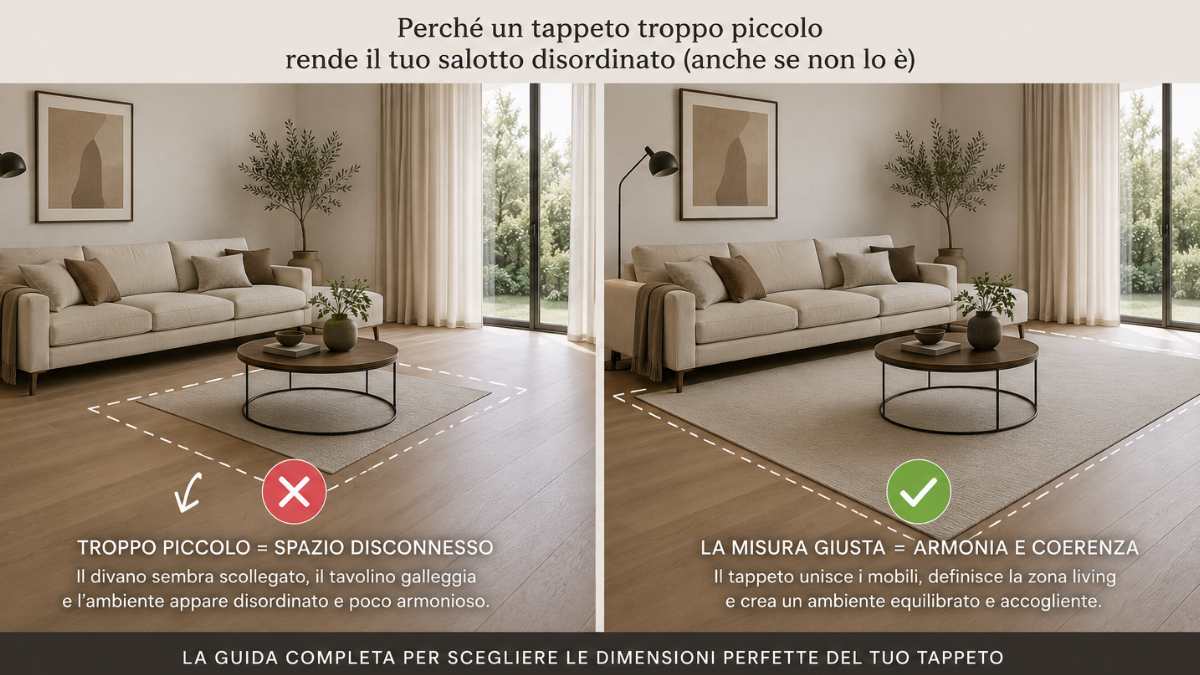
Muuto, a Danish brand founded in 2006 with a stated “New Nordic” philosophy, has built part of its identity on rugs with dense textures and soft colors. Their Stacked carpetdesigned by Julien De Smedt, available only in the 200×300 cm and 250×350 cm versions. There is no small size. The reason is simple: the project only works when the carpet has enough mass to communicate with the furniture around it. A reduced form would betray the logic of the piece.
On the contrary, in the corners of many mass-market furniture stores – and here one can without much diplomacy refer to the carpet section of Homes of the World in some periods – the most exposed formats are those between 120 and 160 cm, because they cost less, take up less space in the warehouse and are easily sold to those who have not yet measured their living room. The market seems convenient. Then the carpet arrives at the house.
When the carpet isolates the sofa: three specific scenes
To understand the problem in its practical dimension, it is worth illustrating three real, not hypothetical, configurations.
First scene: living room about 4 meters long, with corner sofa in light gray 270 cm, coffee table 120×60 cm, carpet 160×230 cm placed under the coffee table. The legs of the sofa are all on the parquet. The carpet is too short to include only the front legs. The corner seems to lean against the wall for lack of alternatives. The table sits on the carpet, but precariously, with the edges protruding from the perimeter. The living room does not exist as a zone: is sum of pieces.
Second scene: same living room, same sofa, carpet replaced with 230×340 cm. The two front legs of the corner go into the carpet by about 20 cm. The table is contained. The side chair touches the edge with one leg. Suddenly there is an area, a visual perimeter that says “here you sit”. The surrounding parquet is no longer an unfinished floor but a free space around a defined area.
Third scene: Studio apartment 35 square meters, two-seater sofa, no coffee table. A 120×170 cm rug under the feet of the person sitting. This is the only situation in which a small shape makes sense: not as an aesthetic choice, but in response to a real proportion. The rules change when the scale changes. In a compact studio apartment, a large rug can saturate the space. But this is the exception, not the model for introduction into a living room of 25 square meters.
Measure before you choose: the rule that no one really applies
The basic rule for choosing a carpet for the living room is to measure the perimeter occupied by the main furniture and add at least 30-40 cm per side. It is not an approximate estimate: it is a minimum threshold below which the carpet loses its anchoring function. If the sofa is 220 cm wide and the coffee table protrudes 40 cm in front, the surface to be covered is already approximately 220×130 cm. The carpet should contain this geometry, not partially under it.
IKEA has among its formats the Stoense carpet in 200×300 cm, sold for around 149 euros in the polypropylene version. It’s not a great rug in terms of quality, but it shows that a decent size for an average living room doesn’t have to be prohibitively expensive. The barrier isn’t as cheap as you think: it’s shrewd. The small rug seems like a more manageable, less demanding, easier to change market. In fact, it is a choice that pays off every day in terms of the visual coherence of the living room.
For those on a bigger budget who want to invest in a durable piece, brands like it Square — known mainly for console fabrics but with a range of very high-quality rugs — or Paola Lenti with its outdoor-indoor rugs made of high-strength synthetic fibers, offer tailored forms that eliminate the problem at its root. A Paola Lenti rug in Rope or Aquarama can cost from 800 to 3,000 euros depending on the form, but it is an object that lasts decades and maintains its geometry over time without distorting at the edges.
The size that works depends on where you put the sofa legs
There is a debate among interior designers that does not have a universal answer: all the legs of the sofa in the carpet, only the front ones or not at all? The three options produce different results and all can work, as long as it is a conscious choice and not the result of a carpet that is too small and leaves no alternatives.
Shortchange all feet on the carpetthe living room becomes compact and autonomous. Works well in large rooms where you want to define a precise island. It requires a generously sized rug: for a 220 cm sofa plus armchair, we are talking about at least 270×370 cm. With only the front feet on the carpet, you have an effective visual compromise and more flexible in size. Without feet on the carpet, the rug becomes a separate decorative element from the sofa: it may work in some very controlled modernist environments, but in most living rooms of the house it creates exactly the island effect you want to avoid.
In an apartment with light oak parquet, a cream boucle sofa and a 240×340 cm sand-colored raw wool carpet with the front legs of the sofa around 15 cm in circumference: this minimal overlap is enough to create continuity. The carpet does not disappear under the sofa, but it is not separated from it. The living room exists as a single space and the parquet around it does not compete with it.
What remains, after measurement and selection, is a living room in which the furniture ceases to look as if it is waiting for something.



