


A ladder leaning against the wall of an apartment in Stockholm, a few terracotta planters, ropes stretched between the steps: these elements are enough to understand why Northern Europe has turned the home garden into a design object. It’s not putting plants on a staircase. It’s a construction system that has a precise logic, and that logic is worth understanding before you buy even a nail.
The project we describe was born from observing how Scandinavian carpenters deal with dynamic loads: instead of blocking everything rigidly, they distribute the weight through knots and tensioners. Applied to a vertical vegetable garden, this principle produces a structure that adapts, breathes and does not peel off the plaster after the first abundant watering. The visual effect is neat, almost minimalistic. But it’s the mechanics that make it really interesting.
The ladder is not a support: it is the backbone of the project
It all starts with the choice of ladder. Not a hardware store with steps too close together, but a solid wood staircase with steps at least 30-35cm apart. Beech or ash versions are preferable to spruce, which works more with moisture. Some use reclaimed vintage stairs, which have the advantage of already having seasoned wood: if the steps can support an adult’s weight, they will hold any combination of pots and wet soil.
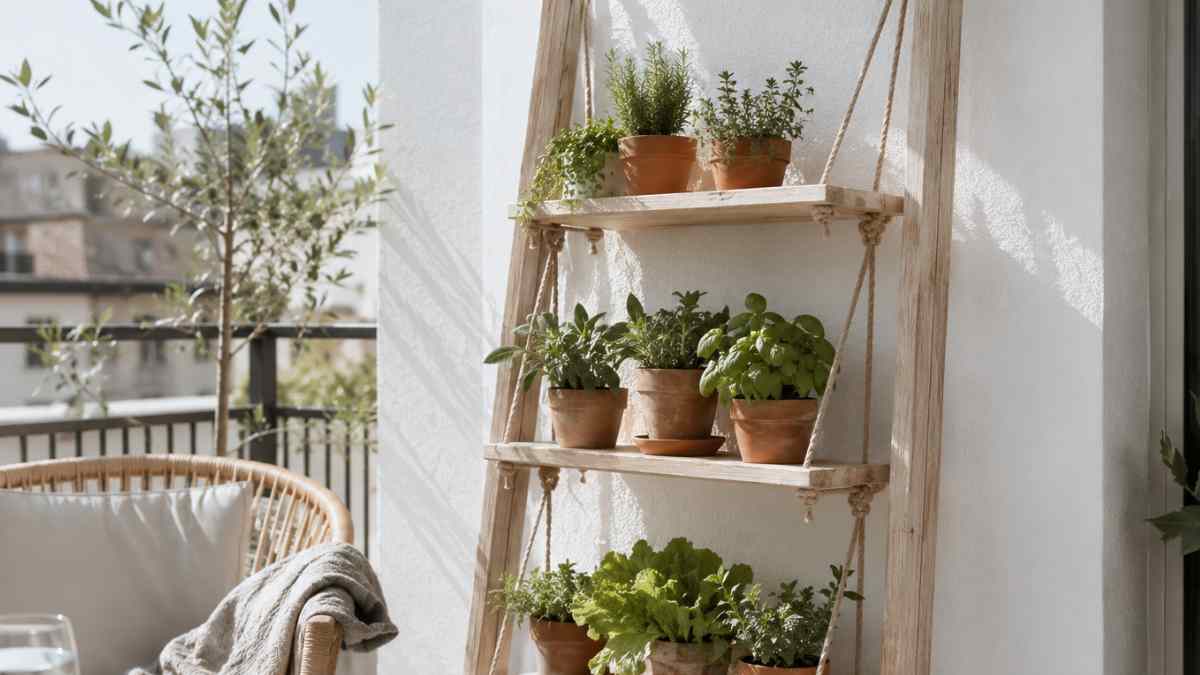
The ladder can stand leaning against the wall in the traditional sense, or used in the open easel position, which offers surface on both sides. In this second case, the suspended shelving system is placed only on the inner side and the structure becomes fully self-supporting: without wall fixing, suitable for those who live for rent. The distance between the ladder and the wall, when supported, must be at least 10 cm to allow air circulation.
The heart of the project: shelves suspended in geometric nodes
The shelves are made of pine or birch wood, minimum thickness 18 mm, treated with a ecological water repellent impregnation agent water based. Products such as Osmo Holzschutz Öl-Lasur or Rubio Monocoat protect wood from moisture without releasing substances into edible pots. The natural color or white lime integrates with the Scandinavian aesthetic without overpowering.
Each shelf is drilled in the four corners with a 10-12mm drill bit, wide enough for the string to pass through with some slack. The strings chosen for this project are not random: they are used Polyester braided nautical ropes or high-strength jute braids, with a minimum diameter of 8 mm. Marine ropes withstand breaking loads of more than 500 kg and do not deteriorate with moisture. Jute is more aesthetically pleasing but needs to be replaced every couple of seasons if exposed to frequent rain. For patio use, the navy option is safer.
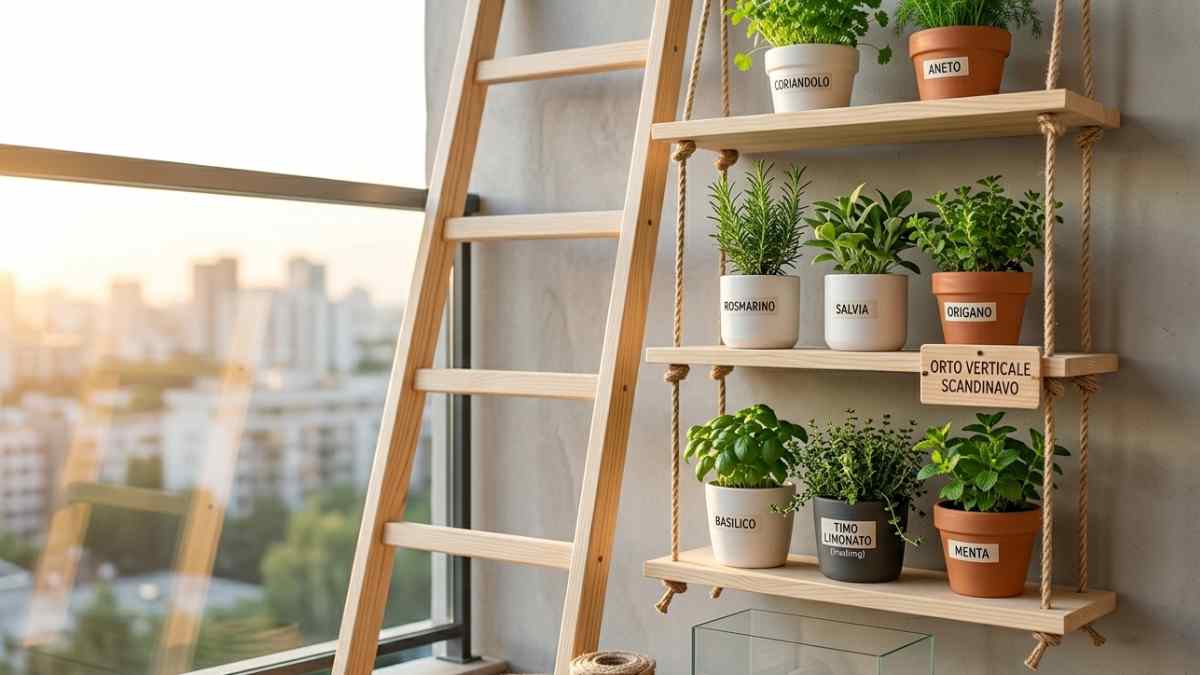
The locking system under each hole is the detail that defines the entire structure. Two approaches can be used: h nautical figure eight knot (more stylish, non-slip, removable) or the stainless steel cable clamps, more industrial but practical for those not familiar with ropes. In both cases, the physical principle is the same: the weight of the shelf and vessels is transferred to the knot or clamp, which presses the wood, stabilizing the shelf horizontally without the need for a rigid attachment to the ladder.
The two vertical ropes are then hooked to the ladder rungs with simple wrap around knots or via screw carabiners if you want a quick system for disassembly. The height of each shelf is adjusted simply by moving the knots along the rope.
Balancing the weights: the part no one explains
A 60cm shelf with three 14cm pots filled with moist soil easily weighs 8-10kg. Multiplied by four shelves, the structure carries a total load close to 40 kg. If properly distributed, these burdens become an advantage: the load itself stabilizes the systemlowering the center of gravity and reducing the risk of the ladder moving.
The problem arises when the weights are not balanced laterally. If one side of the rack has twice the weight of the other, the board tends to lean along the chord axis, creating twist. The solution is simple: arrange the vases starting from the center towards the edges and never put the heaviest vase in a corner position. The lower shelves should accommodate the taller and heavier plants (tomatoes, peppers), the upper ones should accommodate light aromatic herbs (basil, thyme, chives). This lowers the center of gravity of the entire structure.
A detail that makes the difference: the saucers. Without them, each watering carries water into the string, accelerating its wear. It is preferable to use pots with a built-in water reservoir, such as the Lechuza Cube models or the cheaper Elho B.For Soft, both with a self-contained pot system that also reduces the frequency of watering.
Aesthetics, plants and some magazine selections
The work works visually because it doesn’t try to hide the structure: the rope is visible, the knots are part of the design, the wood isn’t painted to cover the grain. It is an aesthetic that has little rustic and a lot constructive, close to the world of Scandinavian craftsmanship that brands like Ferm Living or Menu have codified in the last decade in objects costing a few hundred euros.
For plants, the choice is not only aesthetic. Mediterranean aromatic herbs (rosemary, sage, oregano) tolerate drought well and are suitable for high shelves where watering is more difficult. Basil requires constant moisture and a sunny position. Cut lettuce and watercress also grow in indirect light. Avoid climbing plants on the shelves: the roots do not have enough volume in a terrace pot and the branches create a visual disturbance that breaks the vertical linearity of the work.
The color palette that works best is one that leaves the wood natural (blonde or pickled white) and uses non-glossy terracotta or clay-colored recycled plastic containers. The green of the plants does the rest. Adding colorful vases is the quickest way to make everything look thrift store-bought.
Those who have built this type of construction notice, usually in the second season, that the system begins to respond by itself: the pegs hold up well, the ropes skate evenly, the plants find their light by slightly rotating the pots. There’s something unexpectedly satisfying about seeing a hardware store project behave like an object of thought.



