


In just a few years, matte black has conquered Italian bathrooms with a speed rarely seen in furniture. Faucets, siphons, towel bars, shower handles: everything is blackened. It was a genuine aesthetic paradigm shift, an understandable reaction to the shiny chrome that had dominated for decades with its aseptic luxury hospital air. Brands responded enthusiastically, architects’ projects on Instagram reinforced the message, and the result was a mass adoption that transformed the black faucet into a symbol of a certain idea of domestic modernity.
The problem is not aesthetic. The problem is the tap water.
When design meets domestic water chemistry
Limestone is not democratic. In cities like Milan, Rome, Florence, the water hardness exceeds 30 degrees Celsius, which means that every drop that is allowed to evaporate on a dark surface leaves a perfectly visible whitish residue. In a traditional chrome faucet, these traces are combined with reflections. In one black matte finisheach drop is a statement of intent. Anyone who has installed a shower column with a black profile already knows what we are talking about: two weeks after installation, the feeling is that of an object that was never completely clean, even when it was just.
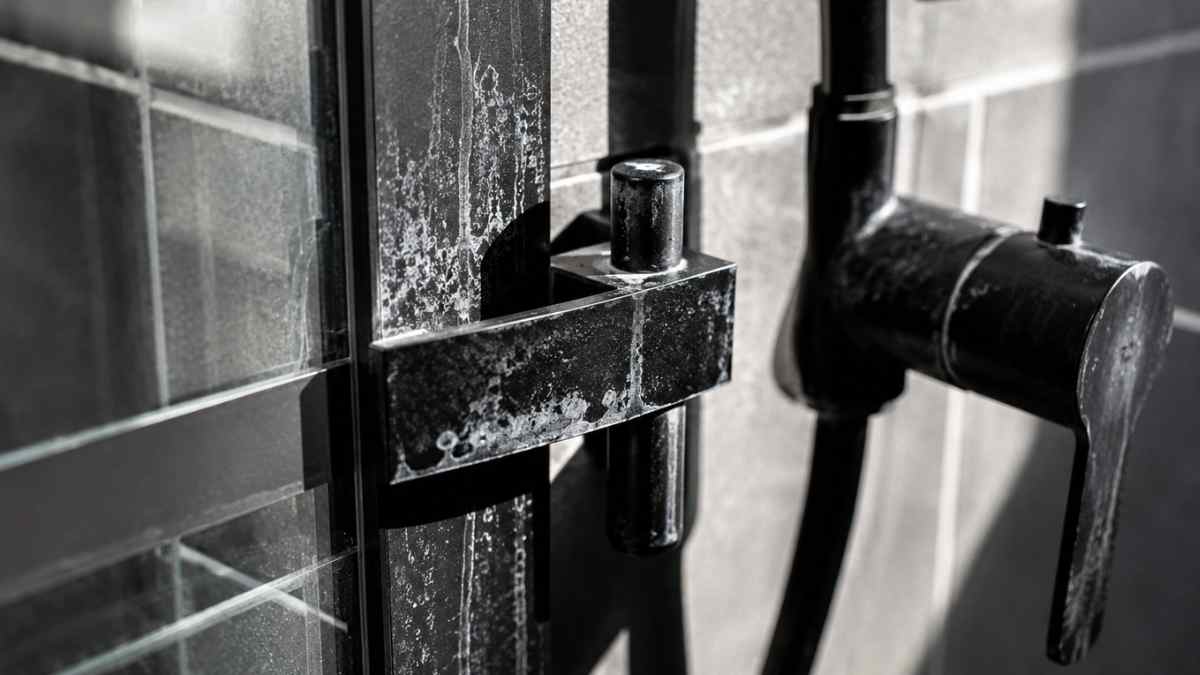
Hansgrohe, one of the manufacturers who pushed most convincingly for the matte black finish in the Metropol range, explicitly states in the care instructions to dry taps after each use with a soft cloth. A recipe that, in the daily practice of a family, is equivalent to asking to make the bed with perfect angles every morning: logical in theory, concretely abandoned after the third day.
The shower profile is the most vulnerable point
Among all elements in black finish, i shower cabin profile they are the ones who suffer the most. The very geometry of the problem is relentless: vertical and horizontal surfaces that get wet with every use, corners where water pools, materials with matte textures that retain deposits better than any smooth surface. The black anodized aluminum profiles, used by manufacturers such as Samo, Novellini or Arblu in their most refined lines, are quite resistant to mechanical abrasion. The problem is that the aggressive detergents needed to remove the encrusted scale tend to dull the finish further, creating an uneven effect that is difficult to correct.
Some installers recommend products based on diluted citric acidbut here too consistency and care is needed: incorrect concentrations or too long contact times destroy the anodization. Matte black, in the shower, is a material that requires almost professional maintenance to maintain the photographic effect it was sold with.
How did it happen so fast?
It is worth understanding the mechanics of this diffusion. Black in bathrooms has already been present in high-end design since at least 2015, driven by studies such as Piet Boon’s in the Netherlands and by Australian residential projects that had clearedgunmetal and brushed black on contract area. In Italy the boom arrived around 2019-2020, boosted by social media and a generation of DIY renovators looking for a quick way to give character to otherwise anonymous bathrooms.
The transition from contract to a typical residence brought with it a structural problem: in professional projects black is used sparingly, calibrated to specific surfaces, accompanied by materials such as terrazzo or microcement that balance it. In the average home versiontaps, drains, towel rails, mirrors, shower profiles and sometimes even bathroom fixtures have all been blacked out, making it look more like a stage set than a lived-in environment. And ensembles, by definition, do not withstand everyday use.
Who pulls back and where does it go?
Signs of saturation are visible in the 2024 catalogs of the main manufacturers. Grohe has reduced the visibility of the Phantom Black finish in the main campaigns, while investing in communication in warm steel and brushed warm sunset finishes, warm shades that offer character without the brutal contrast of limestone. Fantini Rubinetti, an Italian company based in Pella on Lake Orta, has focused bronze and brushed nickel finishes as a premium alternative to black, with significantly better weather and hard water resistance.
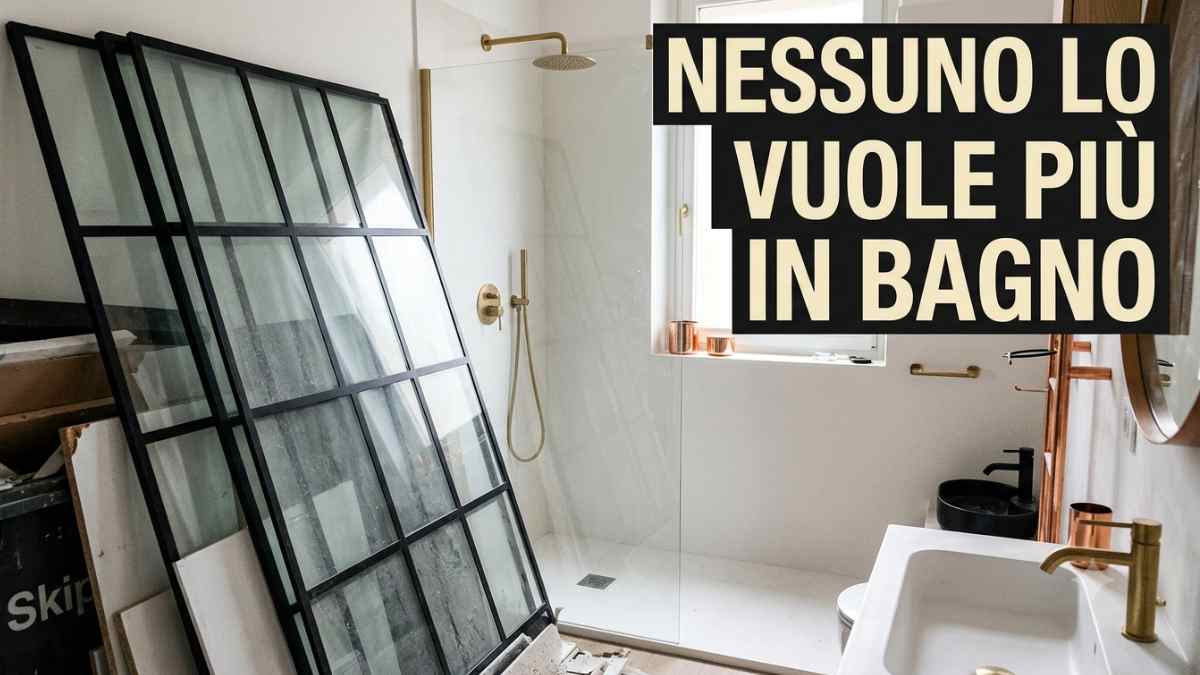
The trend taking hold is not a return to shiny chrome, which remains perceived as dated by those who have renovated their bathrooms in recent years. It is rather a migration towards natural tones: aged brass, brushed copper, stainless steel with satin finish. Materials that accept the signs of time instead of fighting them, that don’t require impossible cleaning and that surprisingly age better than a matte surface designed to look timeless.
Meanwhile, those with black-lined bathrooms learn about white wine vinegar, microfiber cloths, and patience. Or is already collecting offers for change.



