


Within a few years, the Monstera Deliciosa it has conquered every type of home: from the student studio to the magazine loft, from the shared office hallway to the millennial bedroom. Its silhouette has become almost a graphic icon even before an actual plant. Cushion covers, wall prints, tattoos, breakfast mugs. However, almost no one, at the time of purchase, thinks about what will happen when this twenty-centimeter plant becomes what it is meant to be: a rainforest plant. With all that this implies in terms of space, structure and mainly weight. The problem is not aesthetic. It’s natural, it’s specific, and it’s about the relationship between how this plant grows and how the average Italian apartment is built. A problem that manifests slowly and is therefore ignored until it is inconvenient to ignore.
A plant designed to climb, not stand still
Monstera in nature does not grow vertically like a tree. It’s going up. It uses its aerial roots to cling to the trunks of forest trees and climbs, seeking the light upwards. In an apartment, without sufficient support, it does all it can do: expands laterally, bends, stretches towards the nearest light source. The result, after two or three years, is a plant that occupies a significant horizontal space, with leaves that can exceed sixty centimeters in diameter and stems that tend to bend progressively.
Meanwhile, the jar grows accordingly. A healthy adult monstera requires a container at least 40-50 cm in diameter, with a free-draining substrate that includes pine bark, perlite and potting soil. A set that when wet can easily weigh between 15 and 20 kg. If you add support, often a coconut pole 120cm or morethe total weight becomes important. Placing it on a shelf, on a piece of furniture that is not anchored to the wall, or worse, on a floating parquet, is a choice that has consequences over time.
Brands such as Lechuza or Elho have developed water storage pot systems designed also for large plants, but no container solves the basic structural problem: where do you naturally place a plant that tends to take up more and more space outside?
The floor is not neutral
The issue of weight is systematically underestimated. Floating wood floors, very common in renovations in the last twenty years, are not designed to withstand static loads concentrated in one spot. A heavy jar left stationary in the same position for months can leave permanent marks, distort the slats or in the most serious cases compromise the click lock of the installation system.
Glued parquet is more durable, but even there a chronically water-retaining saucer can cause localized swelling over time. Those with stoneware or marble think they are safe, and in general they are, but even on hard surfaces the vase must be placed on trolley with rubber wheels for two reasons: it distributes the load, and it allows you to move the plant without lifting it when it reaches fifteen kilos.
Companies like Serax or Skagerak sell stylish pot trolleys, made of metal or teak, designed just for this. They are not an optional decorative accessory. It is a functional component that many discover only after damage.
Aerial roots are not a decorative detail
One of the most photographed features of monstera is its aerial roots: those brownish, filamentous structures that emerge from the nodes of the stem. In the common imagination it is a botanical curiosity, something to be shown to visitors. They are actually active organs that seek out active substrates to attach to and absorb moisture from.
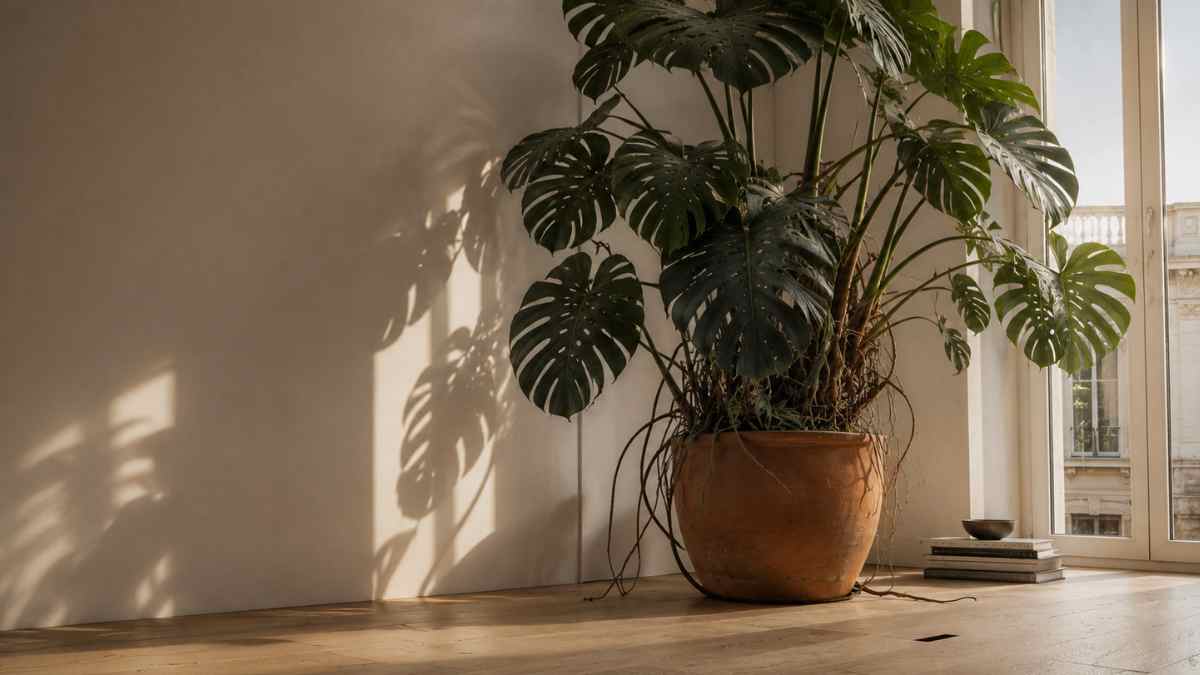
If left free in a domestic environment, aerial roots explore nearby surfaces. Over the course of a season they can fit into the cracks of a bookcase, wrap around a furniture leg, stick to a porous plaster wall. This is not imagination: it is the epiphytic behavior that this plant has developed over millions of years of evolution. Remove them by force Once connected it can damage both the plant and the surface.
The solution adopted by more experienced growers is to direct them immediately to a stick of wet moss or sphagnum moss, which satisfies their urge to cling without having to look for alternative supports on the furniture. Patrick Morris, one of the most followed botanists in the world of European houseplants, described the native monstera as “a plant that you have to actively manage in the early years, not just water.”
How much space do you really need?
A Monstera deliciosa in optimal conditions, after three years of regular growth in a well-lit apartment, can reach 1.5 meters in height and a lateral opening of 80-100 cm. The mature leaves of the standard variety develop the characteristic holes, the lateral incisions, only after the third or fourth year. Before then the leaves are entire and smaller, which feeds the illusion that the plant remains contained.
The minimum recommended space for an adult plant is not a corner, but an area with at least 80 cm of free radius on three sides, not less than one meter from an east or west exposure window. A direct southern exposure in summer burns the leaves. A position that is too far from light slows growth but does not stop lateral expansion, which continues in a chaotic and uncontrolled manner.
Il monstera adansoniia variety with smaller circular holes and more limited growth, is technically more manageable in small apartments, but sells for much less because it has less direct visual impact. In Italian garden centers it is difficult to find it displayed with the same prominence as deliciosa, however it is often the most reasonable choice for those who do not have fifteen square meters of living space.
Not a condemnation, a conscious choice
None of this is to say that monstera is the wrong plant for an apartment. It means that it is a growing plant, that needs real physical space, that interacts with surfaces and the floor in ways that a ficus or an orchid never will. Those who choose it knowing this can organize accordingly: a dedicated corner, a suitable floor, a well-thought-out support, a trolley under the vase.
What remains, after years of growth in an environment that accommodates it well, is a plant with an architectural presence that can hardly be duplicated by any other native greenery. Ripe leaves have a scale that changes the perception of the space around them. This is not an effect you get with a pothos or a calathea. But it has a structural cost worth knowing before, not after.



