


At 2008 High-definition digital printing has entered industrial ceramic production and completely changed the rules of comparison between real wood and wood-effect stone. Before this technology, recognizing a ceramic tile from an oak tree was immediate: the texture was repetitive, the grain very regular, the color flat. Today the most advanced manufacturers print each board with a different digital file, eliminating the repetition of the pattern on surfaces of even hundreds of square meters. The visual effect, at normal distances and even up close, is almost indistinguishable from real wood.
This technical change turned a comparison that for decades was a comparison between aesthetics and practicality into a comparison almost exclusively between technical performance and budget. The stone has united the wood on a visual level. What still separates it from real parquet is other aspects, some in favor of ceramic, some in favor of wood, and neither is objectively superior in absolute terms.
What’s really going on under your feet: tactile and thermal perception
Parquet has a thermal conductivity much lower than porcelain: wood is naturally insulating and provides a feeling of warmth to the touch even when the environment is not heated, because it dissipates the body temperature of those who step on it less quickly. Stoneware, as a high-density ceramic material, has a higher thermal conductivity and feels cold to the touch, especially in the early hours of the morning or in winter without active heating.
This difference is not just perceptual: it is measured. Wood has thermal conductivity all around 0.12-0.18 W/mKwhile the porcelain ones are in between 1.0 e 1.3 W/mKup to ten times higher. In rooms with underfloor heating, this difference is greatly reduced because the heat is actively supplied, but in the absence of radiant heating, walking barefoot on ceramic tiles in winter is a much colder experience than on parquet.
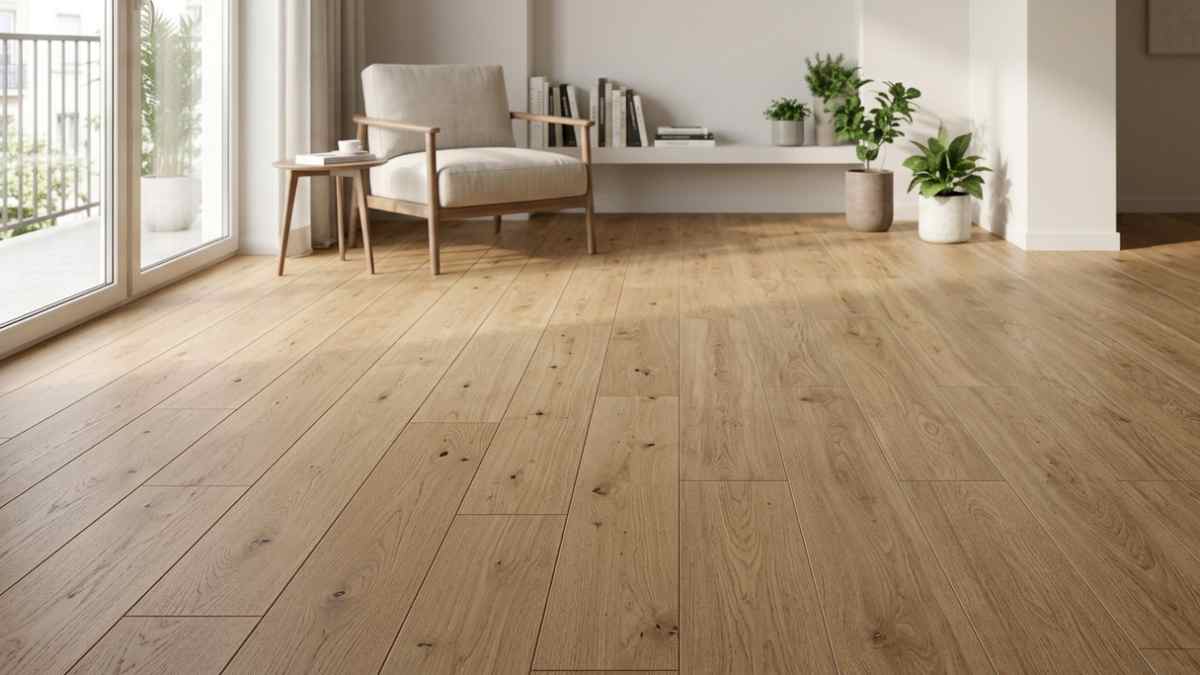
On an acoustic level, wood absorbs part of the foot noise thanks to its porous cellular structure, while stoneware, as a dense and rigid material, reflects the sound more clearly. In condominium apartments, this difference has a specific impact acoustic comfort it is perceived both by those living in the apartment and by the downstairs neighbors and must be dealt with by a suitable layer of sound-absorbing underlayment in both cases.
Resistance and maintenance: where stoneware wins without a doubt
In terms of mechanical strength and moisture resistance, porcelain has no rival. It is a material with almost zero water absorptionless than 0.5% according to EN ISO 10545 standards, which makes it usable without any additional treatment in the bathroom, kitchen, laundry and on outdoor terraces. It does not swell, it does not deform, it does not form mold under the surface. It resists scratches, bumps and heavy pet stomping without needing periodic maintenance beyond routine cleaning.
Parquet, even in the most durable versions, such as oak treated with oils or high-resistance paints, remains a hygroscopic material: it absorbs and releases moisture based on environmental conditions, which makes it not recommended for bathrooms with direct showers or in areas with constant exposure to water. Even in the most technically resistant versions, such as laminated wood parquet with UV finishes, prolonged exposure to moisture causes the boards to swell, crack or lift over time.
As for routine maintenance, stoneware only requires cleaning with neutral detergents, without periodic treatments. Varnished parquet requires minimal maintenance, but even more attention to aggressive detergents and standing water. Oiled parquet, which many choose for the most natural aesthetic effect, instead requires a periodic relubricationevery 12-18 months in high traffic areas, a maintenance cost that ceramic has never had.
The real cost: price of the material and cost over time
The purchase price varies widely in both categories, but comparable ranges tell a clear story. A prefabricated parquet inside selected oakthickness between 10 and 14 mmgood quality but not luxury, generally costs between 45 and 80 euros per square meterposes excluded. A wood-effect porcelain stone of equivalent technical quality, with high-definition digital printing and a large plank shape, is among the 30 to 60 euros per square meterwere also blocked.
The most important difference, however, concerns the cost of installation and maintenance over time. Parquet installation requires specialized work and longer times, with costs that exist 25-35 euros per square meter for floating or fixed installation. Rock installation, while also requiring professionalism, generally has faster turnaround times and similar or slightly lower costs, between 20-30 euros per square meter.
In the long term, parquet has an advantage that it does not: it can be sand and repaint several times during its useful life, regaining its original appearance even after decades of wear and tear, at a cost of approx. 15-25 euros per square meter for intervention. Stoneware, if badly damaged, cannot be repaired: it must be replaced in the damaged area, with a real risk that you will no longer find the same color if years have passed since the original purchase.
Brands and technical references to guide you in your choice
Among the Italian producers of wood-effect porcelain stoneware, Marazzi with the collection Wood mood m Flourish in order Walden is among the most cited references for the level of detail in the reproduction of the grain and for the variety of formats available, including very large thicknesses to 20×180 cm which reduce the number of visible joints and increase the visual continuity of the surface. Casalgrande Padana with the line Newwood offers versions with a structured surface that also reproduces the roughness of the brushing of real wood to the touch, a detail that until a few years ago was impossible to obtain in ceramics.
At the front of the parquet, Listone Giordano it remains one of the leading Italian references for the quality of its choice of wood and finish, with prices that reflect the brand’s top position. For those looking for a good compromise between quality and price, Garofoli m Itlas offer pre-finished oak parquet with oiled or varnished finishes at more affordable prices without sacrificing too much quality of cut and wood selection.
Where to choose what: map by environment
In environments with direct exposure to water, bathrooms with open showers, laundry rooms, outdoor terraces, stoneware is the technically correct choice without valid alternatives. Parquet in these areas, even in the most durable versions, remains a compromise that requires constant attention and has a limited lifespan compared to ceramics.
In living, sitting and bedroom areas, where exposure to water is occasional and limited, the choice becomes more a matter of personal preference. Those who prefer the tactile comfort, thermal insulation and aesthetics of the living material, with its natural variations, will find in real parquet an experience that stoneware does not fully reproduce, despite technological progress. Those who favor absolute practicalityresistance to time without maintenance and the possibility of extending the same material in the kitchen, bathroom and terrace for absolute visual continuity, you will find the most rational solution in stoneware.
An increasingly common intermediate solution in modern renovation projects is the combined use: real parquet in living rooms and bedroomswood-effect stone in the bathroom and kitchen areas, chosen in the same shade or in a very close shade to maintain visual continuity between rooms without compromising functionality in areas at risk of moisture.
Neither material is a wrong choice. Parquet ages and does so by showing the marks of those who have lived on it. Stoneware remains identical to itself no matter how much time passes. The question to ask yourself before choosing is not which is prettier, but whether you are willing to live with a material that changes or prefer one that never changes.



